
- LPC (Licensed Professional Counselor), New Jersey
- Master's in Clinical Counseling & Mental Health
- 7 years of experience in the mental health field
- Telehealth in all 21 New Jersey counties
- Teens, adults, and older adults
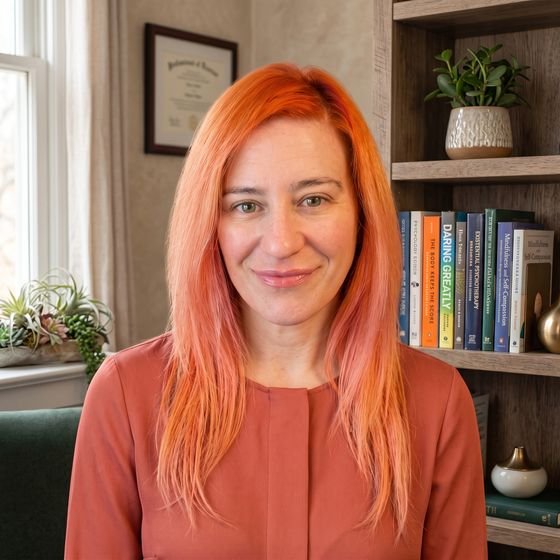
Meet Shannon Cahill, a therapist for all of New Jersey.
Shannon Cahill is a New Jersey–licensed therapist providing compassionate, evidence-based teletherapy to teens, adults, and older adults — individually, as couples, and as families — anywhere in the state. She helps clients work through anxiety, trauma, OCD, depression, stress, relationship challenges, and substance use — with a style that's both direct and empowering.
Direct, compassionate, and solution-focused.
Her approach is direct, compassionate, and solution-focused. She integrates evidence-based practices — including Cognitive Behavioral Therapy (CBT), Dialectical Behavior Therapy (DBT), and Motivational Interviewing — within a supportive, judgment-free space that encourages insight, accountability, and growth. Together, she and her clients address the patterns underneath the presenting concern and move forward with clarity and confidence.
Across every level of care
Shannon brings 7 years of experience across the full spectrum of care — from inpatient and partial hospitalization to intensive outpatient and outpatient settings — supporting people navigating complex mental health and addiction concerns. She understands how overwhelming emotional and behavioral challenges can feel, and focuses on helping clients build practical skills, strengthen resilience, and create meaningful, lasting change.
She holds a Master's in Clinical Counseling & Mental Health from Walden University, and is an LPC (Licensed Professional Counselor) in the state of New Jersey. Licensure means meeting the state's supervised-experience and examination requirements, and practising under its code of professional conduct.
Shannon is currently in the final stages of completing her Ph.D. in Psychology and is actively fulfilling her clinical residency requirements. That study sits alongside her clinical work rather than changing the credential she practises under: she sees clients as Licensed Professional Counselor (LPC).
Serving all of New Jersey online
Shannon sees clients by secure video in every county in New Jersey — from Bergen and Sussex in the north to Cape May and Cumberland in the south — so where you live in the state does not decide whether you can work with her. Being based in West Long Branch, NJ means in-person sessions are available across Monmouth County as the practice grows, but the telehealth practice is statewide and is how most clients are seen. You only need to be physically located in New Jersey during your session.
Her goal is to help clients improve emotional regulation, strengthen their relationships, and build the tools to move forward with greater stability and purpose.
Licence verification: New Jersey licence number 37PC01195800. You can verify any LPC licence through the New Jersey Division of Consumer Affairs.
Evidence-based methods, matched to you
Shannon is trained in a range of approaches rather than a single model, so the therapy can fit the person instead of the person fitting the therapy. These are the ones she draws on most.
- CBT
Cognitive Behavioral Therapy
Changing the thought-and-behaviour loops that keep a problem running.
- DBT
Dialectical Behavior Therapy
Skills for intense emotion, distress tolerance, and relationships.
- EFT
Emotionally Focused Therapy
Repairing the emotional bond underneath relationship conflict.
- CPT
Cognitive Processing Therapy
A structured PTSD treatment focused on trauma-related beliefs.
- MI
Motivational Interviewing
Resolving ambivalence about change without pressure.
- TF-CBT
Trauma-Focused CBT
Trauma treatment designed for teens and their caregivers.
- ERP
Exposure & Response Prevention
The specialised approach for OCD and compulsive rituals.
- MBCT
Mindfulness-Based Cognitive Therapy
Present-moment skills that interrupt rumination and relapse.
- Narrative
Narrative Therapy
Separating you from the problem and re-authoring the story.
- Family
Structural & Cognitive Behavioral Family Therapy
Changing household structure, roles, and patterns.
In Shannon's words: what working together is like
The first session
We talk about what brought you here, what you have already tried, and what you want to be different. I will ask about your history, health, and support system — not to file you under a label, but because context changes what will help. You decide how much to share, and nothing is required on day one.
The sessions after that
Expect an active hour. I ask questions, offer reflections, and teach skills where skills are what is needed. Most weeks you will leave with something specific to notice or try before we meet again — small enough to be realistic, targeted enough to matter.
How we know it is working
We revisit your goals regularly and adjust. Progress in therapy is rarely a straight line, and a hard week is not a failure. What matters is the direction over time — and that you can see it, not just take my word for it.
Confidentiality
What you share stays between us, with the narrow legal exceptions every licensed clinician works under: risk of serious harm to you or someone else, suspected abuse or neglect of a child or vulnerable adult, and court orders. I will explain these clearly at the start, and you can read the full detail in the HIPAA Notice of Privacy Practices.
Where I cannot help
This is an outpatient telehealth practice and it is not an emergency service. If you need urgent or around-the-clock care, crisis services and emergency departments are the right route — call or text 988, or call 911. I am also licensed only in New Jersey, so you need to be physically in the state during sessions.
“Change is rarely about finding the one thing you have been missing. It is usually about doing a few honest things consistently, with someone in your corner who will not let you talk yourself out of them.”
Shannon Cahill, LPC